On Japanese trains you do not have to fold the pushchair.
There are just two symbols to learn.
JR East states officially that "you may board without folding your pushchair". The same sentence continues, however: "we ask for your consideration towards other passengers". The two go together.
*This is an informational-only article and contains no affiliate links. We note this for transparency, as a site-wide policy.
The conclusion firstThere are just two symbols to learn
The pushchair mark was agreed in March 2014 by the Council on Pushchair Use on Public Transport and Elsewhere, and became a JIS standard in May 2015. Japan’s Ministry of Land, Infrastructure, Transport and Tourism explains that it was standardised so as to be "understandable by anyone, including foreign visitors, and usable permanently".
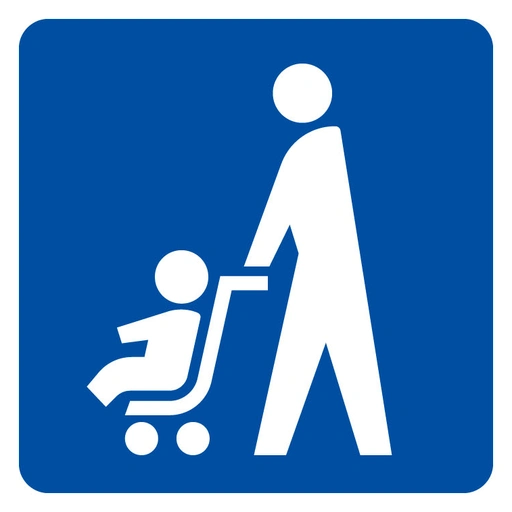
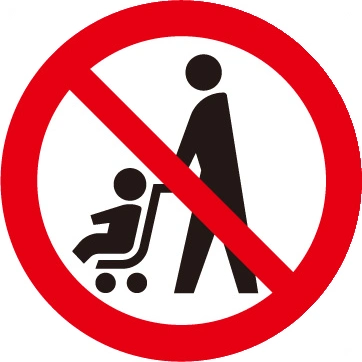
Source: Ministry of Land, Infrastructure, Transport and Tourism website, "About the pushchair mark". The distributed image files are used as supplied (no change to colour or proportions).
The permitted mark = you may use it here MLIT
It denotes "places and facilities that pushchair users can use with confidence (lifts, the designated spaces in train and bus vehicles, and so on)". What you are looking for on board is the vehicle space displaying this mark.
The prohibition mark = escalators
It denotes "places and facilities where pushchair use is prohibited (escalators and the like)". Do not take it on an escalator. Find the lift. That alone settles almost every decision inside a station.
You can navigate without reading Japanese
Graphic symbols do not depend on language. You do not need to read the notices; you only need to spot the mark and your route is decided. It is the single most useful piece of official information for visitors.
Even within "buses", local buses and highway buses are handled in opposite ways. Trains are from JR East’s official answer, local buses and twin pushchairs from MLIT documents, and highway buses from the Fujikyu Bus Q&A (as of August 2026). Private railways and metros differ from operator to operator.
No folding required. What to watch is a fall from the platform
JR East’s official answer is: "You may board with your pushchair without folding it, but we ask for your consideration towards other passengers while using it."
- On board, look for the vehicle space displaying the pushchair mark. MLIT cites "lifts, the designated spaces in train and bus vehicles, and so on" as examples of where this symbol is displayed
- On platforms, wind and the camber can set a pushchair rolling. While you are on the platform, do not let go of it
- Private railways and metros vary by operator. Do not assume "all Japanese railways are the same"
It does take up space in a crowded carriage, so move to the area beside the doors and lock the wheels. Rather than insisting on a right, that small effort changes how the people around you react.
Local busesSpeak to the driver; do not simply wheel aboard
On buses too, not folding is the rule, but there is a procedure that assumes the driver will help. On 31 March 2020 MLIT published "On the use of twin pushchairs on route buses", establishing, after safety trials, that twin pushchairs of standard construction may also be used without folding, provided the conditions are met.
| The bus operator | You |
|---|---|
| The driver assists with boarding and alighting on request | Fasten the pushchair’s seat belts |
| For side-by-side models, the driver helps fold up two seats | Secure it facing the rear, with belts at two points |
| If someone is already seated there, the driver asks them to move | Lock the wheels |
| Explain the securing method clearly on the website and elsewhere | While moving, keep one hand on the handle |
The "facing the rear" instruction is one you will almost certainly get wrong if you do not know it. And since securing the pushchair is the driver’s job, a word before you board is the right move. The MLIT document notes, as background, that "roughly one in every hundred women is said to give birth to twins, triplets or other multiples each year". A twin pushchair is not a special case; it is an anticipated use.
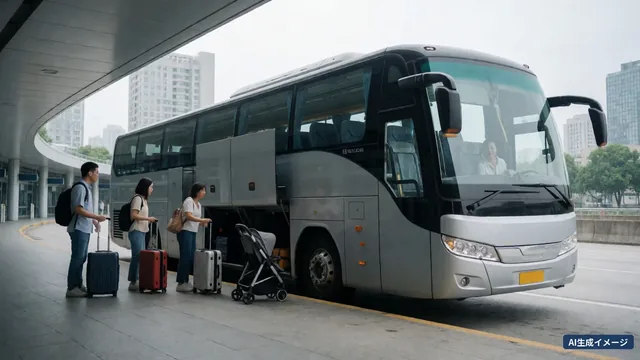
The one that works the other wayHighway buses alone mean "fold it and check it in"
The Fujikyu Bus Q&A, for instance, states that "wheelchairs and pushchairs may be folded and checked into the luggage hold beneath the coach".
- Everything above about "no need to fold" concerns trains and local buses. It does not apply to highway buses
- Meanwhile, booking sites’ FAQs sometimes say nothing about pushchairs at all. Assume handling differs by operator and check before booking
- The same goes for airport coaches. Decide how you will load before you reach the stop, so that you can fold the pushchair as soon as you arrive
- If you want it the moment you step off, think about the order in which you load. Deep in the hold means hard to retrieve on arrival
The luggage rules for highway buses (two items per person, each within 50 cm × 60 cm × 120 cm and 30 kg, varying by operator) are set out with a worked example in our guide to travelling from Tokyo to Lake Kawaguchi.
ShinkansenNo reservation needed for a pushchair. It is the suitcase that catches you out
On the Tokaido, Sanyo, Kyushu and Nishi Kyushu Shinkansen, a pushchair requires no advance reservation regardless of its size.
- On these lines, "oversized baggage" means an item whose three dimensions total more than 160 cm and up to 250 cm
- Pushchairs, wheelchairs, musical instruments and sports equipment need no advance reservation, whatever their size
- "Seats with an oversized baggage area" may also be used by people who need somewhere to put a pushchair (reserving is recommended if you want one)
- Bringing oversized baggage without a reservation costs a 1,000 yen fee (tax included)
- The oversized baggage areas are provided on 16-car Nozomi, Hikari and Kodama services
This system belongs to the Tokaido, Sanyo, Kyushu and Nishi Kyushu Shinkansen. JR East’s Tohoku, Joetsu and Hokuriku Shinkansen operate a different system, so check the line you will be riding. The classic large-family mishap is worrying about the pushchair and then being charged 1,000 yen for the suitcase (our Shinkansen large luggage guide).
A tool worth usingYou can look up station lifts in English before you go
With "Raku Raku Odekake Net" you can check barrier-free interchange routes before you leave.
- It is run by the Foundation for Promoting Personal Mobility and Ecological Transportation (Ecomo Foundation)
- It covers station and terminal searches and barrier-free route information for interchanges
- As well as railway stations, it includes airport terminals, bus terminals and passenger ferry terminals
- There is an English version (the English links at the top and bottom of the site)
Lifts in Japanese stations are often at the far end, well away from the ticket gates. For a family with two pushchairs and a lot of luggage, changing trains without knowing the route is what costs you the most time. Even just the station where you are staying and the one where you change: look them up the night before.
An honest note: what we left out
Where we could not confirm something, we say so rather than filling the gap with a guess.
We do not know whether two pushchairs plus large luggage fit through a gate or into a lift in one go
No primary source existed, so we make no claim. The practical answer is to send the suitcases ahead to your accommodation and travel with only the pushchairs on the day you change trains.
Private railways and metros follow the common rule first, but the details differ by operator
We did not check each operator’s guidance one by one, but these rules are not devised from scratch by each company. MLIT set the common pushchair mark and the "requests for pushchair users" in March 2014, and it became a JIS standard in May 2015. In a vehicle space bearing the mark, a pushchair may as a rule be used unfolded, on railways and on local buses alike. What differs is the service layer at each company: lift location guidance, pushchair-friendly route information and so on.
You can also hire one at the station (paid, by reservation)
JR East offers a pushchair hire service, "Babycal", at some stations (paid, by reservation). The official FAQ answer reads: "At some stations we offer the pushchair rental service 'Babycal'. (Paid, by reservation.)" Which stations and what it costs varies, so check the participating stations before you travel. For a large family that wants to travel light on arrival day, it is an option.
On the platform warning, we did track down the source
We confirmed the original wording on JR East’s official page: "When using the train, please do not let go of your pushchair, as wind or the camber of the platform may cause it to fall onto the tracks. We also ask that during busy periods you pay attention to your surroundings and take care." — "fall onto the tracks" is stated explicitly. On a platform, do not let go, even briefly.
Pushchairs on Japanese trains and buses: FAQ
On a crowded train, should we fold it after all?
Officially, folding is not required. But "consideration towards those around you" appears in the same sentence. Move to the vehicle space marked with the pushchair mark and lock the wheels — in practice, how you place it matters more than whether you fold it.
Are pushchairs banned on escalators?
The example location for the pushchair prohibition symbol is precisely the escalator. Look for the lift. If you cannot find one, asking station staff is quicker — and that works in English.
Can we take a twin pushchair on a bus?
In 2020, MLIT set out that "use without folding is the basic principle". The conditions, though, are rear-facing, secured at two points, wheels locked, and securing it requires the driver’s help. Have a word as you board.
Can we manage two pushchairs and a large suitcase at once?
On what a ticket gate or lift will actually take, we could not confirm a primary source, so we make no claim. The practical answer is to send the suitcases ahead to your accommodation and travel with only the pushchairs on the day you change trains (our luggage forwarding guide).
Read these next to make getting around easier
📍 See the good to know article index